
State Symbols Scavenger Hunt!
The murals covering the basement windows of the Richmond Town Center building are repainted each year by the community under the guidance of Radiate Art Space. This year's murals are based on the Vermont state symbols. Can you find all of these symbols painted on the murals?
Gather your friends and family and enjoy searching!
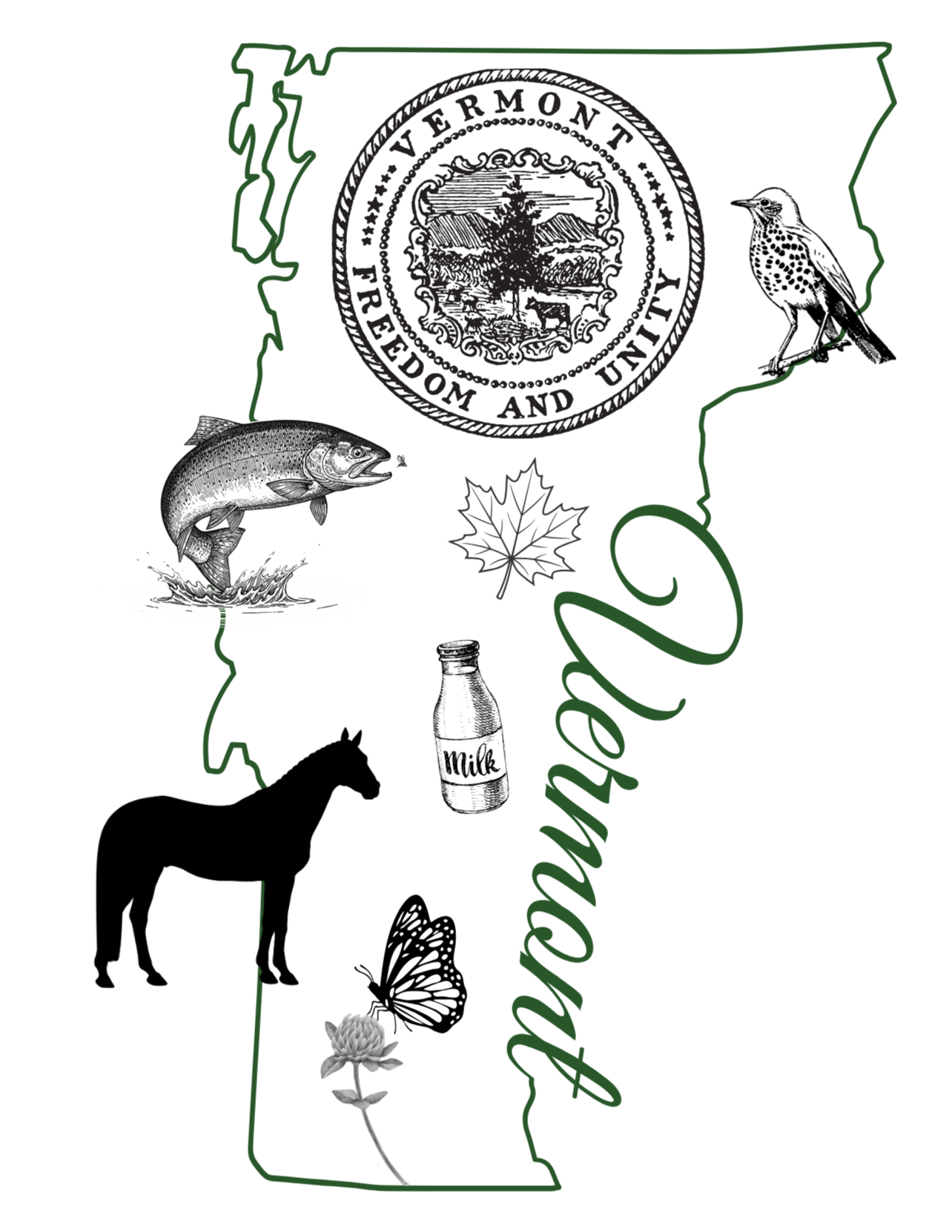
OFFICIAL STATE SYMBOLS
(with the year they were approved by the state legislature)
1779 State Seal
Designed by Ira Allen.
1895 State Flower: Red Clover
The clover represents Vermont’s deep agricultural roots. It is grown to feed livestock and is a favorite pollen source of honeybees.
1941 State Bird: Hermit Thrush
The hermit thrush is known for its sweet flute-like song. It lives in wooded areas across the state during the warm months before migrating south for the winter.
1949 State Tree: Sugar Maple
Also known as hard maple or rock maple, the sugar maple is one of the largest and most important of the hardwoods. Sap from the maple is used to make syrup (maple is also the state flavor of Vermont). Sugar maples are also known for their brilliant foliage in the fall.
1961 State Mammal: Morgan Horse
The breed began in 1789 with a foal named Figure owned by schoolteacher and composer Justin Morgan in Randolph VT. Historically used for clearing land and pulling carriages, the Morgan horse is strong, fast and able to out-work larger horses.
1978 State Insect: Western Honeybee
The honeybee (which is recognized as the official insect of 19 other states!) plays an important role in agricultural. The bees part in pollination is critical to plant and human survival - beeswax and honey are just surplus gifts.
1978 State Warm Water Fish: Walleye
The walleye is an olive‑gold to brown fish with brassy mottling, and it is a popular table fish caught on fishing line in freshwater across North America.
1978 State Cold Water Fish: Brook Trout
The Brook trout, also known as the speckled trout is Vermont’s only native stream dwelling trout. Their existence indicates clean, chilly running streams.
1983 State Beverage: Milk
This designation honors the dairy industry’s vital role in Vermont’s agricultural economy and in its iconic rural landscape.
1985 State Soil: Tunbridge Soil Series
This soil is a low well drained mineral rich soil that formed in glacial til. It is found extensively across Vermont in the mountainous areas.
1987 State Butterfly: Monarch
Vermont's old fields and meadows offer an abundance of milkweed which serve as the exclusive food source for monarch caterpillars. By late summer and early fall, Vermont acts as a staging ground for monarchs as they begin their incredible thousand mile journey south to the mountains of Mexico.
1991 State Gem: Gossular Garnet
These garnets are famous for their fiery red-orange and cinnamon-brown colors and are primarily found at Belvidere Mountain.
1991 State Rock: Marble
Danby, Vermont is home to the largest underground quarry in the world. Vermont marble was used to build the US Supreme Court building and the Jefferson Memorial. Bright white with gray vein patterns define this highly sought after rock.
1991 State Rock: Slate
Slate is found in southwestern Vermont and was first quarried in Fairhaven in 1845. It has a unique color range including red, green, purple, brown, grey and black. Slate is used for roofing shingles (look across the parking lot at the Richmond Library building!), floor tiles and paving.
1991 State Rock: Granite
Vermont granite is a hard, durable rock that was formed deep underground when melted rock (magma) cooled and hardened very slowly. Its many minerals give it a speckled look with pink, white, gray, and black colors. It is quarried heavily in central Vermont and used for home interiors, fine monuments, sculptures, architecture and just recently for new curbs on Main Street in Richmond.
1991 State Mineral: Talc
In Vermont this mineral is found along the eastern slopes of the Green Mountains. It is the softest known mineral on Earth and usually white or grayish green. It feels greasy or soapy to the touch and is widely used in powders, cosmetics, paints, and plastics.
1993 State Flavor: Maple
The maple flavor is always present in Vermont. You can smell it in the steam coming from the sugar houses in early spring, taste it in creemees during the summer and enjoy it on pancakes all year round.
1994 State Reptile: Painted Turtle
This turtle has a dark shell with bright, red and yellow markings on the edges and skin. It loves slow moving fresh waters and quiet streams and can often be seen warming up on logs or rocks in the sun.
1998 State Amphibian: Northern Leopard Frog
Found in marshes, flood plains and wet meadows, this frog grows to about 3-4 inches in length and has green, brown, or yellow skin with oval spots surrounded by lighter borders. It was chosen as a symbol due to its vital role as an ecological indicator and it’s importance in controlling insect populations.
1999 State Fruit: Apple
Vermont named the apple the official state fruit to honor its deep, agricultural roots and economic impact. Early French and European settlers planted the first trees in the 1600’s because the fruit and hard cider were vital to colonial life. By the 1800’s, almost every local farm had its own family orchard. Today local orchards grow over 150 varieties and produce about one million bushels of fruit every year.
1999 State Pie: Apple Pie
Vermont named apple pie the official state pie in the same year that it designated the apple as the state fruit. The designation also highlights local dairy traditions by stating servers should make a "good faith effort" to pair it with milk, ice cream, or sharp cheddar cheese.
2006 State Heritage Livestock: Randall Linebacker Cattle
This rare American cattle breed descended from the 17th century and originated in Sunderland Vermont at the Randall Family Farm. The herd was kept pure-bred for over 80 years. A triple purpose animal - it was used for milk, meat and draft work. In addition to a distinctive white stripe down its back, the cattle’s black ears, muzzle and eye rings make this breed unique.
2013 State Fly-fishing Fly: Governor Aiken Bucktail Streamer
Named after former Governor George D. Aiken, this pattern features a yellow-olive hackle wing, a peacock herl topping, and a bright red tail flag designed to mimic a small baitfish.
2014 State Marine Fossil: “Charlotte Whale”
The “Charlotte Whale” is a 12,500-year-old fossilized skeleton of a beluga whale unearthed in 1849 by railroad workers. It was buried 10 feet deep in blue clay in Charlotte, Vermont and is now housed at the Perkins Museum at the University of Vermont.
2014 State Terrestrial Fossil: The Mount Holly Mammoth
A mammoth tusk and molar were found in 1848 by railroad builders in a peat bog in Mount Holly, Vermont. The Mount Holly Mammoth is North America’s first identified woolly mammoth. Radiocarbon dating shows it died about 12,800 years ago, proving that the last mammoths existed with the early human in New England.
2016 State Vegetable: Gilfeather Turnip
This sweet creamy root vegetable is actually a hybrid cross between a turnip and a rutabaga. It was first grown in Wardsboro, Vermont in the late 1800’s by a farmer named John Gilfeather. Wardsboro holds an annual Gilfeather turnip festival every October!
2024 State Mushroom: Bear’s Head Tooth Fungus
This is a white fungus featuring long, cascading, icicle-like spines that hang downward. It grows on hardwood trees (frequently on sugar maples) during the autumn months.
Want to learn more about how the murals were designed?